


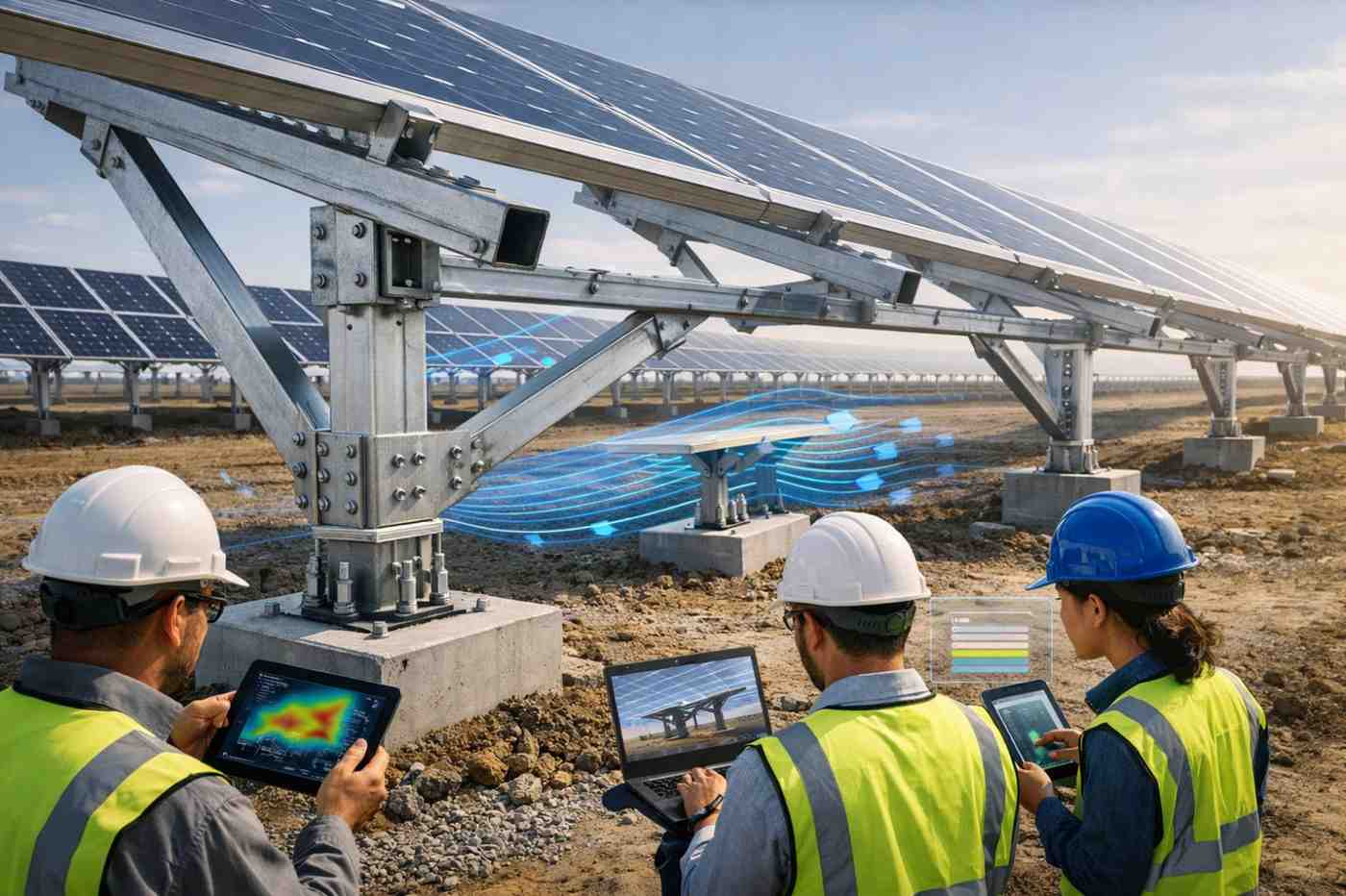
India’s solar sector has matured rapidly over the last decade. What began as cost-driven installations is now shifting toward lifecycle-driven engineering. In 2025, one of the biggest changes happening quietly across the industry is how EPC companies are redesigning solar mounting structures to reliably last 25 years or more — matching the actual lifespan of solar modules.
Earlier failures of solar plants were rarely due to panels. Instead, mounting structures, foundations, and steel selection emerged as weak links. EPCs have taken note — and engineering practices are evolving fast.
This article explains what has changed, why it matters, and how modern solar structures are being redesigned for long-term reliability.
Why the 25-Year Question Became Critical
Solar PPAs typically span 20–25 years. However, many early projects faced structural issues within 5–8 years, including:
Premature corrosion
Foundation settlement
Wind-induced fatigue cracks
Fastener loosening
Galvanization peeling
These failures led to:
High O&M costs
Generation losses
Insurance disputes
EPC liability claims
As a result, bankability audits and investor scrutiny now focus as much on solar structure design as on modules and inverters.
Shift #1: Design Philosophy — From “Safe” to “Survivable”
Earlier approach:
Structures designed for minimum code compliance
Static load assumptions
Limited fatigue analysis
New EPC approach:
Survivability-based design
Dynamic load modeling
Lifecycle stress evaluation
What’s changing technically?
Wind load calculations now consider gust factors, turbulence intensity, and resonance
Seismic design uses zone-specific response spectra
Thermal expansion is modeled for steel elongation over decades
This shift alone has reduced long-term failure risk significantly.
Shift #2: Steel Selection Is No Longer Generic
One of the biggest EPC learnings:
Not all steel behaves the same over 25 years outdoors.
Modern EPCs now insist on:
Consistent mechanical properties
Traceable steel chemistry
Predictable galvanization performance
New steel expectations:
High-strength structural steel with controlled carbon content
Compatibility with hot-dip galvanization
Uniform thickness for predictable coating life
This is why EPCs increasingly collaborate with specialized solar structure manufacturers, rather than fabricating from mixed-source steel.
Shift #3: Corrosion Engineering Became a Core Discipline
Earlier mindset:
“Galvanized steel is enough.”
Reality:
Coastal zones
Industrial pollution belts
High-humidity regions
Agricultural ammonia exposure
All accelerate corrosion far beyond assumptions.
New EPC corrosion practices:
Zinc coating thickness selected based on C2–C5 corrosion categories
Drainage holes redesigned to avoid water traps
Elimination of sharp edges that cause zinc thinning
Separate corrosion models for bolts, rails, and columns
Many EPCs now design structures assuming controlled zinc loss per year, ensuring 25-year residual protection.
Shift #4: Fasteners & Connections Are Treated as Critical Components
Field data showed:
Most early failures occurred at connections, not members
Modern EPC practices include:
Structural-grade fasteners instead of commercial bolts
Anti-loosening solutions for vibration zones
Torque-controlled installation protocols
Corrosion-matched fasteners (no mixed metals)
This has reduced:
Rattle failures
Clamp slippage
Long-term alignment loss
Shift #5: Foundation Design Is Site-Specific, Not Standardized
Previously:
Same pile design across multiple sites
Minimal soil investigation
Now:
Detailed geotechnical surveys
Separate foundation logic for:
Rocky soil
Black cotton soil
Sandy coastal soil
Flood-prone zones
EPCs now evaluate:
Pull-out resistance
Long-term settlement
Cyclic loading effects
This prevents gradual tilt and misalignment — a silent performance killer.
Shift #6: Digital Simulation & Lifecycle Testing
Large EPCs now rely on:
Finite Element Analysis (FEA)
Wind tunnel simulation references
Accelerated corrosion testing
Assembly stress modeling
Why this matters:
Structures are tested virtually for decades of stress in weeks
Weak points are redesigned before fabrication
Bankability reports gain credibility
This engineering depth was rare five years ago — it’s becoming standard in 2025.
What This Means for the Solar Industry
For EPCs
Lower warranty exposure
Stronger project credibility
Better investor confidence
For Asset Owners
Predictable generation
Lower O&M costs
Fewer mid-life retrofits
For Manufacturers
Higher demand for:
Engineered steel
Consistent galvanization
Precision fabrication
Why Solar Structures Now Define Project Quality
In today’s market:
Panels generate power — structures protect revenue.
EPCs have learned that a solar plant is only as reliable as its weakest structural component. That’s why solar mounting structures are no longer treated as accessories, but as engineered assets designed to last the full project life.
Final Thought
The transition toward 25-year-reliable solar structures marks a maturity shift in India’s renewable ecosystem. EPCs are no longer designing for installation day — they’re designing for decades of wind, heat, corrosion, and load cycles.
This evolution will separate:
Short-term installers from long-term infrastructure builders
Cost-driven projects from bankable assets
Temporary savings from permanent value
Frequently Asked Questions (FAQs)
Solar power plants are designed for 25-year lifecycles. If mounting structures fail early due to corrosion, fatigue, or poor steel quality, the entire project faces power losses, higher O&M costs, and reduced investor confidence.
EPCs now focus on lifecycle-based design, higher zinc coating thickness, controlled steel chemistry, improved fasteners, wind-load simulations, and site-specific foundation engineering.
Inconsistent steel chemistry leads to uneven galvanization and premature corrosion. High-quality structural steel ensures predictable coating life, better fatigue resistance, and long-term structural stability.
