

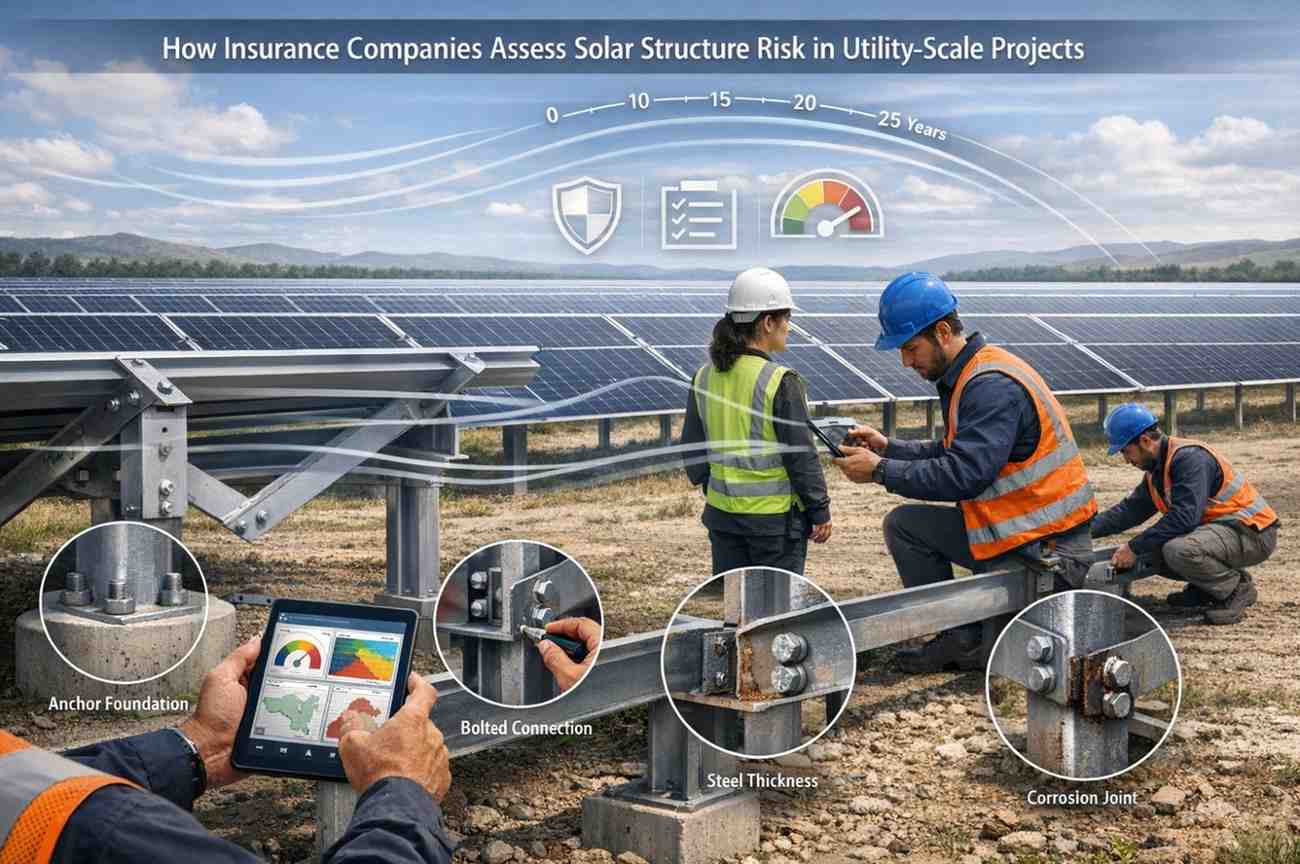
As solar power projects expand across India, insurance companies have become far more cautious while underwriting solar assets. What was once treated as a routine add-on policy is now a deeply evaluated risk product, especially when it comes to solar mounting structures.
Insurance providers no longer see mounting structures as secondary components. Instead, they recognize them as critical risk-bearing assets that directly influence project stability, claim frequency, and long-term loss ratios. Any weakness in structural design, steel quality, or installation practices can significantly increase the probability of claims—ranging from panel damage and structural collapse to business interruption and third-party liability.
This article explains how insurance companies assess solar structure risk, what parameters they evaluate before issuing coverage, and how developers and EPCs can reduce insurance friction through better structural decisions.
Why Solar Mounting Structures Matter to Insurers
From an insurer’s perspective, solar mounting structures perform three vital functions:
They hold high-value photovoltaic modules in place
They absorb environmental and mechanical stresses
They determine how damage propagates during extreme events
If the structure fails, the insurer is exposed to multiple simultaneous claims—modules, inverters, cabling, downtime, and sometimes even grid penalties. For this reason, insurers now treat solar structures as primary risk drivers, not ancillary hardware.
1. Structural Design Validation
The first layer of insurance assessment focuses on engineering design integrity.
Insurance underwriters review whether the structure design complies with nationally accepted standards such as IS 875 for wind loads and relevant IEC guidelines. They evaluate if the design is site-specific rather than generic.
Key parameters assessed include:
Wind zone classification and basic wind speed
Terrain category and topographical exposure
Tilt angle and its impact on uplift forces
Row spacing and aerodynamic interaction
Foundation type and load transfer mechanism
Designs reused across different geographies without recalculation raise immediate red flags. Insurers prefer projects where structural drawings are validated and stamped by certified structural engineers and supported by documented load calculations.
2. Steel Quality and Material Traceability
One of the most frequent causes of structural claims in solar projects is inconsistent steel quality.
Check high-quality structural steel
Insurance companies examine:
Steel grade and yield strength consistency
Chemical composition stability
Manufacturing source credibility
Heat number and batch traceability
Availability of Mill Test Certificates (MTCs)
Untraceable or mixed steel sourcing increases uncertainty and claim probability. Insurers strongly favor projects where steel is sourced from established manufacturers with documented quality assurance systems. Clear traceability from mill to fabrication and finally to site execution significantly reduces underwriting risk.
3. Corrosion Risk and Environmental Exposure
Corrosion-related failures represent a growing portion of insurance claims, particularly in coastal, industrial, and high-humidity zones.
Insurers evaluate:
Galvanization method and coating thickness
Uniformity of zinc coating and edge protection
Soil corrosivity reports
Drainage and water stagnation management
Environmental classification of the project site
Projects that meet only minimum galvanization standards often face early degradation. Insurance companies increasingly reward developers who over-engineer corrosion protection in aggressive environments, as it directly lowers long-term loss exposure.
4. Fabrication and Installation Quality
Even a well-designed structure can fail due to poor execution. As a result, insurers now review EPC execution discipline in detail.
Assessment parameters include:
Fabrication tolerances and hole accuracy
Bolt grade and fastener compliance
Torque application and tightening records
Alignment accuracy and structural plumbness
Foundation depth and anchoring validation
Many insurers now insist on as-built drawings, photographic evidence, and installation checklists. EPCs with standardized SOPs and trained installation teams face fewer exclusions and smoother policy approvals.
5. Operational and Maintenance Readiness
Insurance coverage is no longer limited to the construction phase. Underwriters increasingly evaluate how well a project will be maintained over its operational life.
They assess:
Scheduled inspection protocols
Periodic torque rechecking plans
Corrosion monitoring systems
Access design for maintenance and repairs
Projects without documented maintenance frameworks are often subjected to higher deductibles, narrower coverage, or restrictive clauses.
6. Historical Claim Behaviour and Portfolio Risk
For repeat developers and large EPCs, insurers analyze past performance.
They review:
Frequency and severity of past claims
Root causes of structural failures
Corrective actions implemented
Consistency across project portfolios
Developers with a history of structurally stable projects are considered low-risk clients, enabling them to negotiate better premiums, faster approvals, and improved coverage terms.
How Better Structural Decisions Reduce Insurance Cost
Contrary to popular belief, insurance premiums are not reduced primarily through negotiation. They are reduced through risk visibility and risk mitigation.
Projects that demonstrate:
Robust engineering-led design
High-quality, traceable steel sourcing
Corrosion-resistant structures
Disciplined EPC execution
Transparent documentation
are rewarded with lower premiums, fewer exclusions, and better long-term insurability.
Conclusion
Insurance companies view solar mounting structures as risk multipliers, not cost items. Every decision related to steel quality, design accuracy, fabrication discipline, and installation precision directly influences underwriting outcomes.
For developers and EPCs, investing in structurally sound systems is not just an engineering decision(See:- TMT bars for infrastructure projects)—it is a financial and risk-management strategy that protects assets, improves bankability, and ensures long-term project sustainability.

Pingback: Solar Project Trust: Structure, O&M Discipline & Asset Credibility