

Solar Structure Failures EPCs Still Ignore – Hidden Risks That Threaten 25-Year Plant Performance

solar structure failures

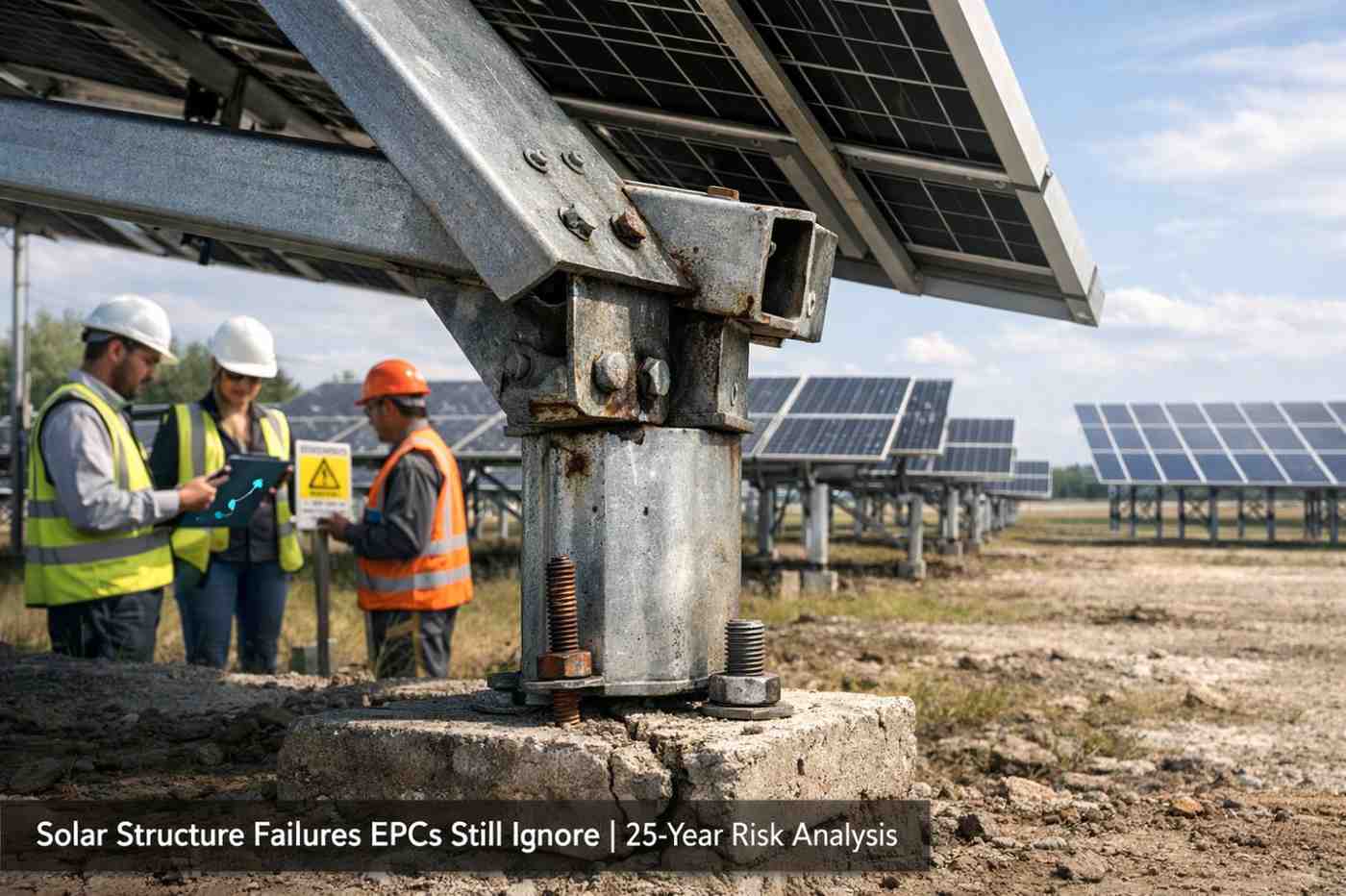
Even after years of operational data, technical audits, and field failures, a surprising number of EPCs continue to overlook critical weaknesses in solar mounting structures. These failures rarely show up during commissioning — they surface quietly after 3, 5, or 8 years, when corrective action becomes expensive, disruptive, and sometimes irreversible.

This part of the series focuses on structural blind spots that EPCs still underestimate, despite claiming 25-year reliability on paper.

1️⃣ Corrosion Under Joints & Fasteners — The Invisible Failure Zone

Most EPCs evaluate corrosion resistance based on overall galvanization thickness, but real-world failures usually start at connection points:

  • Bolt holes

  • Clamped interfaces

  • Overlapping purlins

  • Module rail joints

These zones experience:

  • Micro-cracks during tightening

  • Zinc layer damage during transport or installation

  • Water retention and capillary corrosion

Because these areas are hidden beneath modules, corrosion progresses unnoticed until:

  • Fasteners seize

  • Rails deform

  • Torque values fail during maintenance

Ignored reality: A structure can pass coating standards and still fail at joints within 6–8 years.

“Modern EPCs increasingly rely on engineered solar structure design standards that define corrosion protection, section thickness, wind-load safety, and long-term structural performance — aspects clearly outlined in detailed technical documents such as the Sun Steel Solar Mounting Structure catalogue.”


2️⃣ Steel Fatigue from Cyclic Wind Loads (Not Extreme Wind)

EPC designs often focus on maximum wind speed events, but long-term damage is caused by repetitive low-to-medium wind cycles:

  • Daily gust patterns

  • Seasonal monsoon oscillations

  • Resonance in long-span purlins

Over time, this causes:

  • Micro-fatigue cracks near welds and bends

  • Progressive loosening of bolted connections

  • Rail sagging that misaligns modules

Most failures here are misdiagnosed as “installation issues,” when the root cause is inadequate fatigue modeling during design.

Long-term solar structure failures often begin at the steel level, where inadequate tensile strength or poor fatigue resistance under cyclic wind loads compromises the overall frame — reinforcing why high-quality TMT bars engineered for structural durability remain critical even in non-building applications like solar plants.

3️⃣ Over-Optimised Steel Sections to Reduce Project Cost

To win tenders, many EPCs still reduce:

  • Section thickness

  • Safety margins

  • Steel grade consistency

While this works structurally on Day 1, it leaves zero buffer for degradation caused by:

  • Corrosion loss

  • Mechanical wear

  • Foundation settlement

After a few years, the structure technically remains “standing” but no longer meets:

  • Alignment tolerances

  • Load redistribution safety

  • Module stress limits

This leads to hidden energy losses and long-term warranty disputes.

EPCs focusing only on upfront savings often underestimate how steel price volatility impacts lifecycle cost planning, especially when procurement decisions ignore market trends visible in regularly updated TMT price lists used across the construction and infrastructure sector.

4️⃣ Foundation–Structure Mismatch (Soil Reality vs Design Assumptions)

Foundation failures remain one of the least discussed but most damaging risks.

Common EPC shortcuts:

  • Using generic soil bearing values

  • Ignoring seasonal moisture variation

  • Assuming uniform compaction across sites

Resulting issues include:

  • Differential settlement

  • Tilt drift in tables

  • Stress concentration at column bases

Once foundations move, even the best-designed superstructure starts failing prematurely.

5️⃣ Thermal Expansion Neglect in Long Rows

India’s solar sites face large temperature swings, yet many designs still fail to accommodate:

  • Long rail expansion

  • Constraint locking at joints

  • Thermal stress transfer to modules

This causes:

  • Rail buckling

  • Bolt shear stress

  • Module micro-cracking over time

Thermal movement is slow, silent, and destructive — making it easy to ignore until damage becomes visible.

6️⃣ Quality Variability Across Supply Batches

Even when EPCs specify “approved steel,” inconsistencies across batches lead to:

  • Uneven galvanization adhesion

  • Variable yield strength

  • Different corrosion rates within the same plant

Over 25 years, this creates uneven ageing, complicating maintenance and replacement planning.

Why These Failures Persist

These issues continue because:

  • They don’t cause immediate collapse

  • They rarely appear during warranty periods

  • They’re difficult to trace back to design decisions

Yet they directly impact:

  • Plant uptime

  • O&M cost escalation

  • Asset valuation during refinancing or sale

What This Means for the Solar Industry

The next phase of solar infrastructure maturity isn’t about faster execution — it’s about engineering honesty.

EPCs that ignore these failures risk:

  • Higher long-term liabilities

  • Loss of developer trust

  • Bankability challenges in future projects

Those addressing them early will define the next generation of reliable solar infrastructure.

Leave a Comment

Your email address will not be published. Required fields are marked *

Scroll to Top