

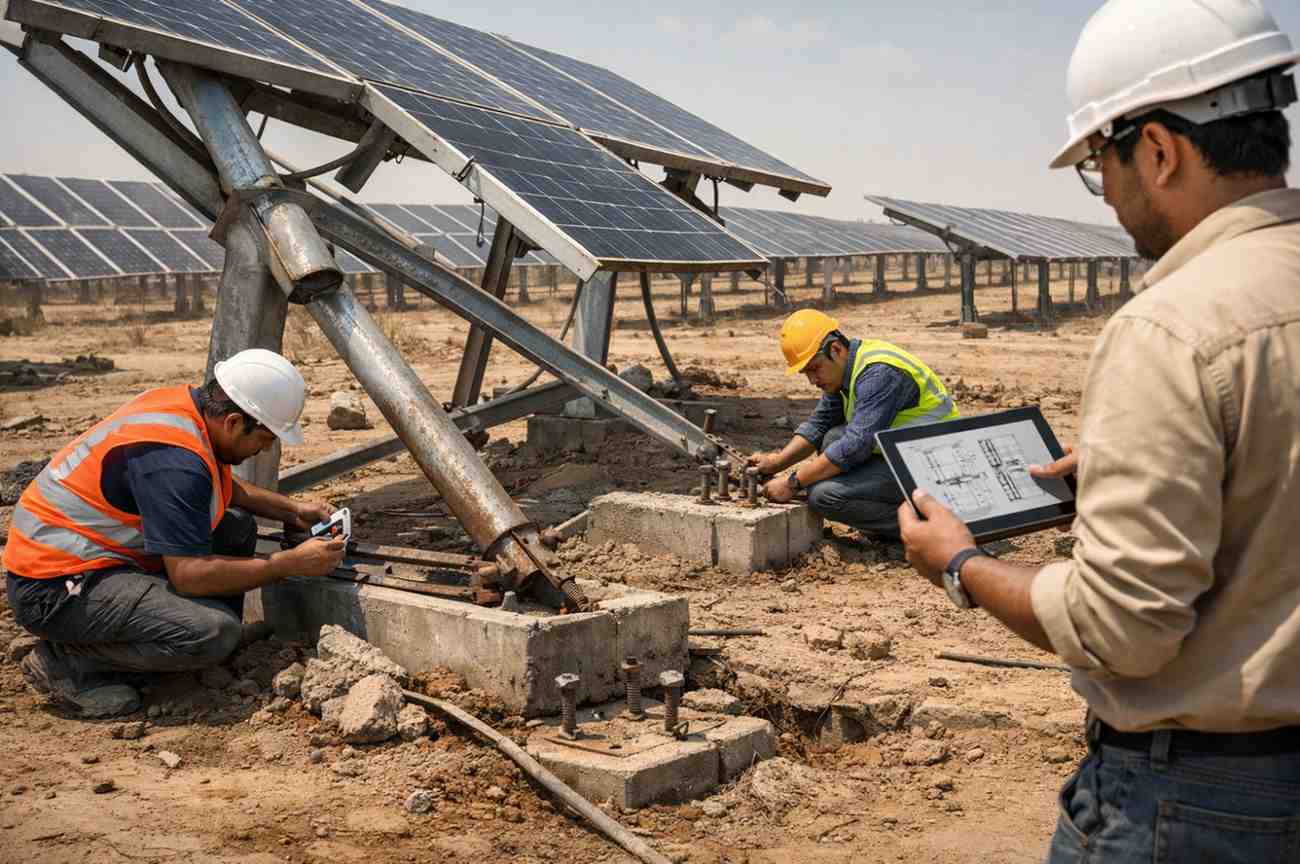
India’s solar capacity continues to expand aggressively, but behind the growth numbers lies a quieter concern—mounting structure failures that rarely make headlines. From deformation during cyclones to corrosion-related breakdowns within just 3–5 years, recent site-level incidents are forcing EPCs and developers to re-evaluate how solar structures are designed, sourced, and installed.
This third part of our solar structure series examines where projects are failing on the ground, why these failures are happening, and what EPCs are learning the hard way.
Why Solar Structure Failures Are Increasing Despite Better Panel Technology
Solar module efficiency has improved significantly, but supporting steel structures have not evolved at the same pace. In many projects, solar mounting structures are still treated as a “cost centre” rather than a load-bearing system exposed to 25+ years of stress.
Recent inspections across utility-scale and rooftop plants reveal a pattern:
Panels survive extreme weather
Inverters recover after outages
Structures take permanent damage
This mismatch is becoming a critical reliability issue.
Failure Pattern #1: Wind Load Miscalculations in Open-Terrain Projects
What’s going wrong
Several ground-mounted solar plants in western and southern India have reported:
Twisted purlins
Tilt angle distortion
Foundation bolts loosening
The common factor? Underestimated wind pressure.
Many EPCs rely on generic wind load tables rather than site-specific assessments, especially in open terrain zones where wind acceleration is higher than predicted.
Insight from recent audits
Projects designed for standard wind speeds often fail during:
Pre-monsoon storms
Cyclonic edge winds
Sudden pressure differentials in large arrays
Steel strength alone cannot compensate for design shortcuts.
Failure Pattern #2: Early Corrosion in Coastal & Industrial Zones
The silent killer of solar structures
Corrosion-related failures now account for a growing percentage of premature structure replacements.
Common findings:
Inadequate zinc coating thickness
Inconsistent galvanization across batches
Weld joints corroding faster than flat sections
In several coastal installations, visible rust appeared within 18–24 months, despite structures being marketed as “corrosion resistant”.
Why this happens
Price-driven procurement
No third-party coating inspection
Lack of lifecycle-based material selection
Once corrosion sets in, structural integrity declines long before visual failure becomes obvious.
Failure Pattern #3: Steel Grade Mismatch & Structural Fatigue
Not all steel behaves the same under cyclic loads.
Field data shows that:
Lower-grade steel sections experience micro-cracking
Repeated thermal expansion weakens bolted joints
Fatigue damage accelerates after year 5
Many EPCs later discovered that the steel used met minimum specs but failed under long-term stress conditions.
This is especially critical for:
Single-axis tracking systems
Elevated rooftop installations
Long-span structures in utility plants
Case Insight: When “Lowest Bid” Became the Costliest Decision
In one multi-MW project reviewed by independent engineers:
Structure procurement saved ~6–8% upfront
Corrective reinforcement cost exceeded 20% of original structure value
Downtime reduced generation during peak months
The lesson repeated across multiple sites:
“Structure failures don’t fail immediately—they fail when repair is most expensive.”
What EPCs Are Changing After These Failures
Based on recent tender documents and EPC interviews, several shifts are now visible:
1. Structure-first design approach
Instead of designing around panels alone, EPCs are:
Finalizing structure design earlier
Running wind & corrosion simulations
Matching steel grade to environmental risk
2. Vendor qualification tightening
Projects increasingly demand:
Batch traceability
Coating thickness certification
Manufacturing process transparency
3. Lifecycle costing replacing unit pricing
More developers are comparing:
25-year performance cost
Maintenance risk
Replacement probability
—not just per-kg pricing.
Why Solar Structures Are Becoming a Strategic Asset, Not a Commodity
The industry is gradually realizing that solar mounting structures directly impact:
Plant availability
Insurance premiums
Long-term IRR
A failure in structure doesn’t just affect steel—it affects:
Power evacuation schedules
Compliance audits
Asset valuation
This is why solar structures are now being discussed alongside modules and inverters in risk assessments.
What This Means Going Forward
As India scales toward higher renewable targets, the margin for error in structural design is shrinking. The failures seen today are early warning signals, not isolated incidents.
For EPCs and developers, the takeaway is clear:
Design depth matters
Material consistency matters
Execution discipline matters
Solar projects are long-term infrastructure assets—and their steel skeleton must be treated accordingly.
Frequently Asked Questions (FAQs)
Most failures occur due to incorrect wind-load calculations, poor corrosion protection, low-grade steel selection, and inadequate foundation design—especially in coastal and open-terrain projects.
Yes. In coastal and industrial zones, inadequate galvanization can cause corrosion within 2–3 years, reducing structural life far below the expected 25 years.
EPCs should use site-specific wind studies, certified steel grades, controlled galvanization thickness, and lifecycle-based procurement instead of lowest-price selection.

Pingback: Why Solar Projects Fail After Year 8 | Structural, O&M & Risk Reality