

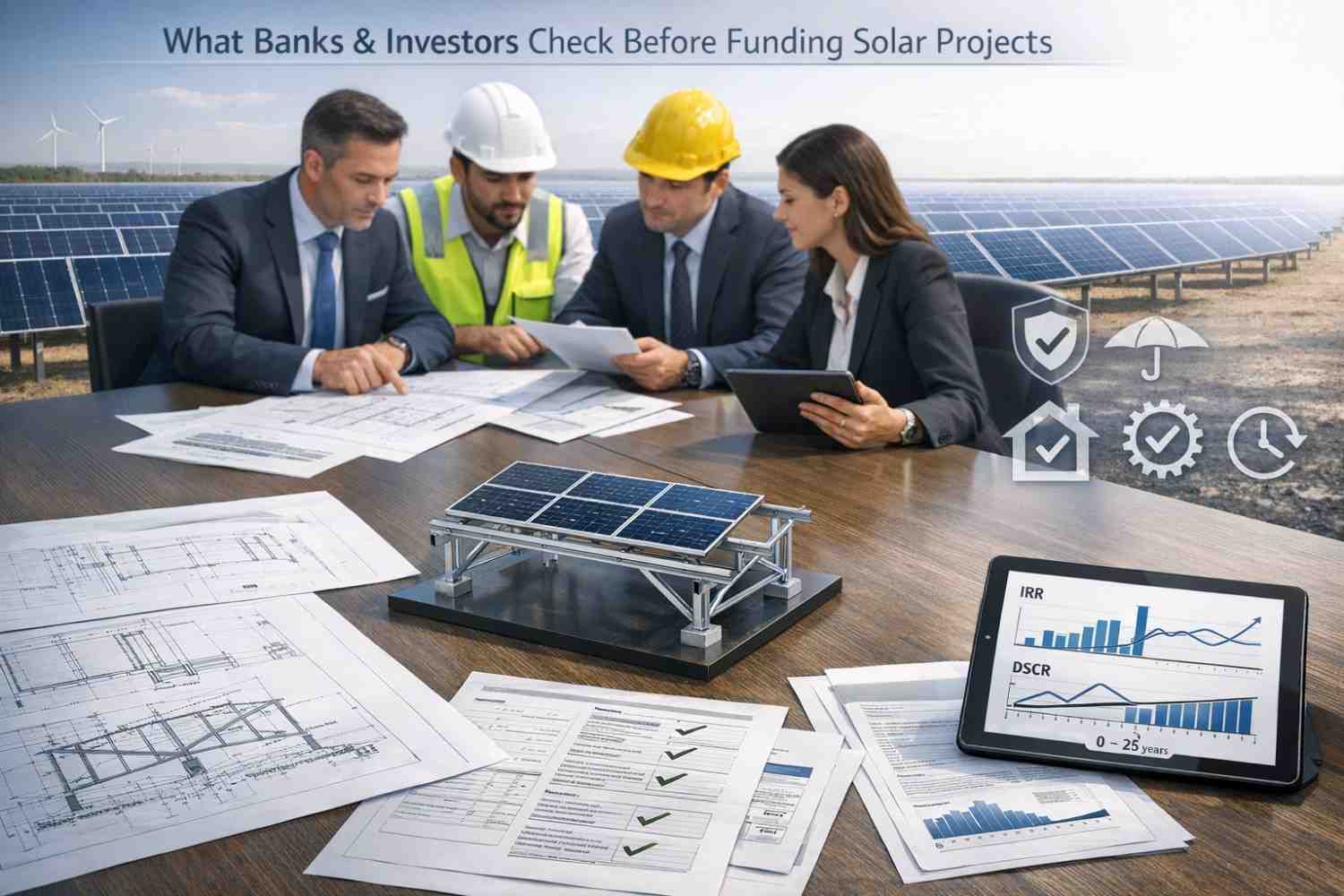
As India’s solar sector matures, financing solar projects has become less about capacity announcements and more about risk control.
In 2025 and beyond, banks, NBFCs, and institutional investors are no longer funding projects purely on PPAs or IRR projections — they are funding engineering credibility, lifecycle durability, and execution discipline.
For EPCs and developers, understanding what financiers actually examine before releasing capital can be the difference between smooth funding and months of due-diligence delays.
This article breaks down the real checklist banks and investors use — especially around solar structures, steel quality, and long-term asset reliability.
1. Project Bankability Comes Before Project Size
One of the biggest misconceptions in the solar industry is that larger MW capacity automatically improves funding chances.
In reality, lenders focus first on:
Predictability of cash flows
Asset life alignment with loan tenure
Risk mitigation in physical infrastructure
A 20 MW plant with weak structural planning can be riskier than a 5 MW plant with strong engineering documentation.
2. Structural Integrity Is a Primary Risk Filter
Why solar structures matter to financiers
From a lender’s perspective, the solar mounting structure is not a balance-of-plant item — it is a load-bearing asset that must survive:
25 years of wind cycles
thermal expansion and contraction
corrosion, moisture, and fatigue stresses
Banks increasingly review:
Design standards used (IS, IEC, ASCE references)
Wind zone and terrain category assumptions
Material grade and coating specifications
Section thickness consistency across layouts
Any mismatch between site conditions and structure design raises red flags.
 This is where engineering-backed solar structure systems — supported by proper documentation and design validation — improve lender confidence.
3. Steel Quality & Fatigue Performance Are Actively Reviewed
Investors are becoming more aware that steel quality directly impacts lifecycle cost.
During technical due diligence, they examine:
Steel grade used in structures
Yield strength consistency
Weld quality and joint detailing
Fatigue resistance under cyclic loads
Poor steel selection can lead to:
bolt loosening
micro-cracks at joints
long-term deformation under sustained load
For projects where high-strength steel elements are used, lenders often ask for:
material test certificates
traceability documentation
supplier reliability history
This is also why TMT bars are scrutinized in hybrid structures, foundations, and auxiliary civil works — as they contribute to overall plant stability.
