

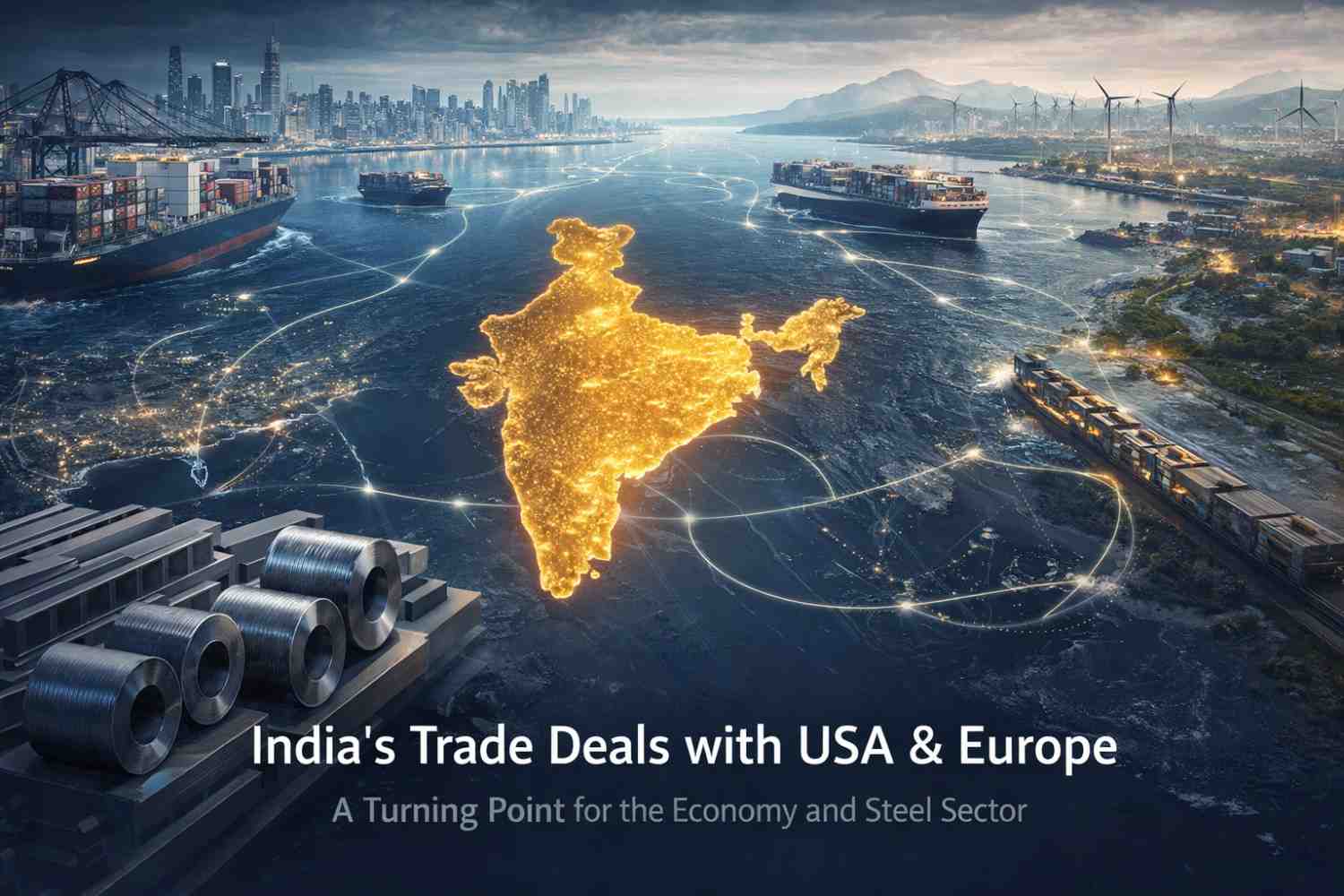
India’s trade diplomacy has quickly moved from sporadic negotiations to a strategic sprint, with major economic partners signing agreements aimed at reducing tariffs, expanding market access, and integrating supply chains. In the past few months, two developments — a renewed trade framework with the United States and a landmark Free Trade Agreement (FTA) with the European Union — have captured the attention of markets and policymakers alike. These pacts are not merely diplomatic gestures; they carry the potential to reshape India’s export landscape, deepen industrial cooperation, and influence key sectors, including steel, manufacturing, and infrastructure.
India–USA Trade Deal: Reducing Barriers, Opening Doors
In early 2026, India and the United States announced a significant trade agreement that recalibrates tariff levels and paves the way for deeper commercial engagement between the two largest democracies. Under this arrangement, the U.S. has agreed to reduce reciprocal tariffs on a wide range of Indian goods from around 25–50% to roughly 18%, eliminating punitive levies that had previously hindered trade flows.
Beyond tariff cuts, the deal also includes provisions that could affect energy procurement, market access, and industrial collaboration. India’s commitments include a shift in energy sourcing strategy, potential increases in U.S. imports of energy and technology, and a stronger focus on government procurement reforms.
Economic Implications
Industry leaders have described the pact as a boost to India’s growth ambition, signaling confidence and predictability for bilateral investment. Major Indian conglomerates see it as a lever for raising the country’s manufacturing competitiveness and innovation capacity.
From a macro perspective, the deal could contribute to a record $1 trillion in exports by FY27, according to export projections driven largely by new trade agreements and tariff reforms. Lower tariffs are expected to increase order volumes, enhance competitiveness, and expand India’s footprint in key markets.
However, not all stakeholders are uniformly optimistic. Some critics, including farmer unions, have raised concerns that the pact could expose certain domestic industries to competitive pressure from subsidized U.S. imports, particularly in agriculture.
India’s steel industry is entering a structural shift-Not a Cycle.
— SG Mart (@sgmart_official) February 7, 2026
From infrastructure demand to global supply realignments, the next phase will redefine margins for both B2B & B2C players.
📊 Read the full analysis 👇https://t.co/2ExXOATaEV#SteelIndustry #IndianSteel #Kashmir pic.twitter.com/ctZEVIBiue
India–Europe Trade Deal: The “Mother of All Deals”
Parallel to U.S. negotiations, India has concluded arguably its most ambitious trade pact ever with the European Union. Dubbed the “mother of all trade deals,” the India–EU Free Trade Agreement was finalized in January 2026 after nearly two decades of negotiation.
This agreement is expected to dramatically expand bilateral trade by eliminating or significantly reducing tariffs on approximately 96.6% of traded goods by value — a move that could double European exports to India by 2032.
The pact also envisions a structural opening of markets for goods, services, and investment, covering sectors such as automobiles, machinery, chemicals, and textiles. While India is negotiating further to secure more favorable terms for steel export quotas, the sheer scale of tariff reduction suggests a historic moment in global commerce.
Strategic Context and Long-Term Potential
Once fully implemented — currently expected by 2027 — the deal would give Indian exporters near-zero tariff access to a market representing nearly $27 trillion in GDP and around 2 billion consumers. This is significant not just for traditional export sectors but also for services, technology, and advanced manufacturing.
It also signals India’s strategic pivot toward diversified economic partnerships beyond traditional reliance on a single market. With rising geopolitical fragmentation and protectionist pressures globally, securing robust ties with both the U.S. and EU provides India with leverage and alternative growth avenues.
Impact on India’s Steel Industry
Although much of the public conversation centers on consumer goods, automotive parts, and agricultural exports, the Indian steel industry stands to feel the effects of these trade pacts in both direct and indirect ways.
Export Prospects
Indian steel products — including iron and steel articles — are already part of the export basket to the United States and Europe, and reduced tariffs could make these shipments more competitive against rivals. While specific steel quotas are still under negotiation in the EU deal, broader tariff reductions and improved market access create opportunities for Indian producers to expand into high-value markets.
This momentum directly translates into higher demand for TMT Steel Bars, which form the structural backbone of infrastructure and industrial construction projects across India.
Supply Chain Integration
Lower trade barriers can also encourage deeper integration of Indian mills into global supply chains. European and U.S. manufacturers might look to source semi-finished steel from India or co-develop products with Indian partners, enhancing export volumes and diversification.
Domestic Sector Competitiveness
On the flip side, increased imports of machinery, precision tools, and industrial equipment from the EU and U.S. could lead to innovation and productivity upgrades in Indian steel production. Access to advanced technology and equipment typically found in Europe and America can help Indian mills become more efficient and environmentally compliant — a long-term competitive advantage.
However, the industry must also be mindful of global competition. Tariff reductions could make it easier for European and American steel producers to target the Indian market, intensifying competition for domestic players already navigating global pricing pressures.
Changes in global trade agreements and tariff structures also influence TMT Bar Prices, making procurement planning a critical factor for builders and manufacturers.
Broader Economic Impacts
Beyond sector-specific outcomes, these trade agreements contribute to a larger shift in India’s economic narrative:
1. Foreign Direct Investment (FDI)
Improved trade relations are likely to stimulate greater capital inflows as global companies seek to scale operations in India to better serve domestic and export markets.
2. Manufacturing Momentum
By aligning tariff regimes with global partners, India strengthens its bid to become a global manufacturing hub — a central pillar of national economic policy.
3. Job Creation & Regional Growth
Clusters in Uttar Pradesh, Gujarat, Tamil Nadu, and other industrial states are expected to benefit from heightened trade activity, especially in engineering goods, textiles, and export-oriented steel products.
4. Confidence in Markets
Tariff certainty and predictable trade frameworks tend to bolster investor confidence, potentially stabilizing stock indices and exchange rates — a positive signal for both domestic and foreign investors.
Conclusion: A New Phase in India’s Global Economic Engagement
India’s recent trade agreements with the United States and the European Union represent more than just tariff adjustments — they reflect a strategic push toward diversified global integration. For the Indian economy, these deals bring the promise of expanded market access, increased exports, and stronger ties with major economic powerhouses.
For industry sectors such as steel, manufacturing, and engineering goods, the implications extend beyond export figures to include technology transfer, supply chain evolution, and competitiveness enhancement.
As competition intensifies, factors such as consistency, certification, and manufacturing credibility increasingly determine market leadership — a trend reflected in analyses like Top 10 TMT Bars in India
In a world where trade dynamics are rapidly shifting, India’s proactive stance signals confidence and readiness to compete on a global stage — beyond traditional narratives, toward sustained economic partnerships that can drive growth well into the next decade.
