

Why Most Solar Plants Don’t Fail in Design—They Fail in Maintenance Discipline
When a solar power plant is commissioned, there is a silent assumption that the hardest part is over. Modules are installed, structures are standing, generation begins, and the project moves into operations. In reality, this is where the most decisive phase of a solar project starts. Over the next 20–25 years, the actual life of the plant will be shaped not by how it was built, but by how it is maintained.
Operations and Maintenance failures rarely make headlines like structural collapses or extreme weather damage. Instead, they appear quietly—through reduced generation, repeated small repairs, corrosion patches, insurance queries, and gradual loss of asset confidence. Over time, these small failures decide whether a solar structure reaches its intended lifecycle or becomes a liability much earlier than planned.
Also Read: Solar Project Structural Design Risks
Why O&M Is the Weakest Link in Most Solar Projects
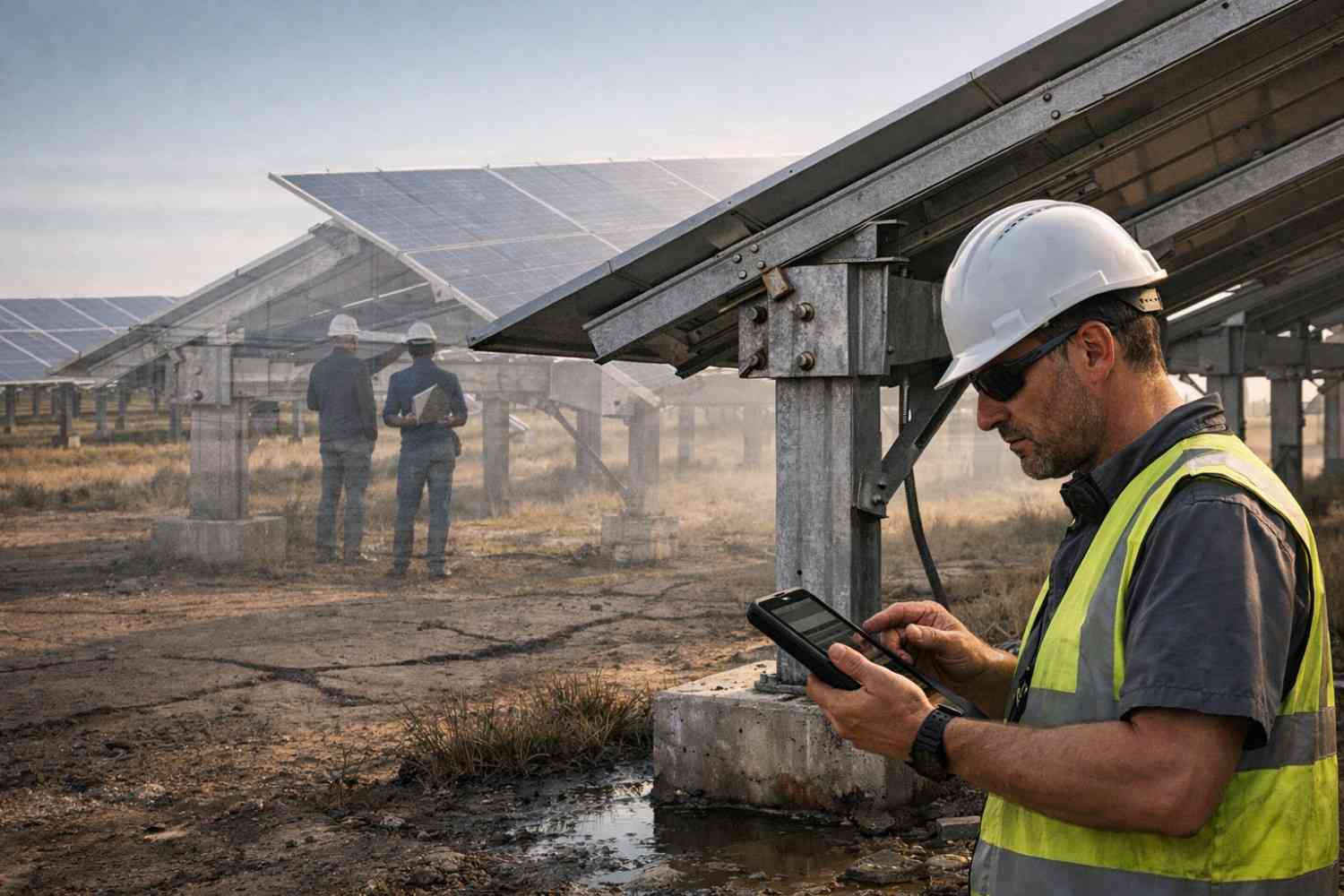
Most solar projects are designed with engineering precision but operated with procedural assumptions. EPC contracts end, O&M budgets shrink, and responsibility shifts from construction teams to lean operational staff. Structural systems, especially mounting structures, are often treated as “static” assets that do not require continuous attention.
This mindset is risky. Solar mounting structures are exposed to constant environmental stress—wind cycles, thermal expansion, moisture, dust, and soil interaction. Without structured inspection and preventive maintenance, even well-designed structures begin to degrade in ways that are invisible until damage is already advanced.
Read: wind load and terrain impact on solar structures
Common O&M Failures That Shorten Structural Life
The most damaging O&M failures are not dramatic events; they are routine oversights. Loose fasteners that are never retorqued. Minor corrosion spots that are ignored because they seem cosmetic. Drainage issues around foundations that are considered non-critical. Over years, these issues compound.
Bolted joints slowly lose preload due to vibration and temperature variation. Misalignment increases stress concentration. Corrosion spreads from edges and welds into load-bearing sections. By the time these problems are noticed, remediation costs are significantly higher than preventive action would have been.
The False Sense of Security After Commissioning
A common belief in solar operations is that if a structure survives the first few monsoons or wind seasons, it will last its full life. This assumption ignores fatigue behavior and long-term material degradation. Structural failures caused by O&M neglect often occur well after the warranty period, when accountability becomes unclear.
Insurance records increasingly show that many mid-life claims are linked not to design flaws, but to maintenance gaps—missing inspection records, undocumented repairs, and lack of corrosion control plans. These gaps weaken claim legitimacy and raise questions about operational discipline.
How Poor O&M Increases Risk Across the Entire Project
Structural degradation does not stay confined to steel members. As structures weaken, modules experience higher stress, clamps loosen, and alignment shifts. This increases the risk of module microcracks, water ingress, and electrical faults. What began as a minor O&M lapse escalates into system-wide performance loss.
Downtime increases, maintenance becomes reactive instead of preventive, and generation forecasts become unreliable. For projects tied to long-term PPAs or refinancing plans, this operational instability directly affects revenue predictability and asset valuation.
Lifecycle Extension Starts With Maintenance Strategy, Not Retrofitting
Many developers assume lifecycle extension means adding reinforcement or replacing components in later years. In practice, the most effective lifecycle extension strategy begins on day one of operations. Structured inspection schedules, torque audits, corrosion monitoring, and documentation discipline preserve structural integrity far more efficiently than late-stage retrofits.
Projects that follow disciplined O&M practices often show minimal structural degradation even after a decade of operation. These plants retain mechanical stability, face fewer insurance issues, and maintain stronger relationships with lenders and asset managers.
The Role of Documentation in Long-Term Asset Confidence
One of the most overlooked aspects of O&M is documentation. Insurers, auditors, and investors increasingly demand evidence of maintenance—not verbal assurance. Inspection logs, photographic records, corrective action reports, and maintenance schedules are now part of asset credibility.
Projects with strong documentation frameworks find it easier to justify insurance renewals, negotiate better terms, and support refinancing discussions. In contrast, plants with undocumented maintenance struggle to prove that failures were unforeseeable, often leading to disputed claims.
Why O&M Discipline Separates Durable Assets from Fragile Ones
Two solar plants may look identical at commissioning, but over time their paths diverge. The difference is rarely design alone—it is operational discipline. One plant treats structures as living assets requiring care; the other treats them as finished work.
Over 25 years, this difference determines whether a project achieves stable returns or faces escalating risk, rising costs, and declining confidence. O&M failures do not just shorten structural life; they redefine the economic life of the entire project.
Conclusion
Solar mounting structures are built to last decades, but only if operations and maintenance practices support that intent. Most lifecycle failures are not the result of poor engineering, but of neglected maintenance and undocumented decisions. In a sector increasingly judged by long-term performance rather than installation speed, O&M discipline has become a strategic advantage.
Projects that invest in structured maintenance, early intervention, and documentation do more than extend structural life—they protect revenue, reduce risk, and preserve asset value across the full lifecycle.

Pingback: Why Solar Projects Fail Due Diligence Despite Strong Performance