

What Auditors, Lenders, and Buyers Discover Too Late
In the solar industry, performance data often creates a false sense of security. As long as generation numbers look healthy, projects assume they are financially safe, technically sound, and future-proof.
But due diligence tells a different story.
Across refinancing, asset sale, insurance renewal, and storage integration exercises, many solar projects fail not because they underperform — but because they cannot explain themselves under scrutiny.
Due diligence is where optimism ends and evidence begins.
Why Due Diligence Is Getting Tougher
A decade ago, solar due diligence focused primarily on generation forecasts, land titles, and PPA validity. Today, the scope is far wider — and far deeper.
Auditors, lenders, and buyers are no longer asking “Is the plant running?”
They are asking “Can this asset be trusted for the next 15–20 years?”
This shift reflects a maturing industry. As solar assets age, risk does not disappear — it transforms. And due diligence has evolved to uncover that transformation.
Performance Masks Risk — Until It Doesn’t
Strong generation numbers can hide structural fatigue, corrosion progression, deferred maintenance, and undocumented modifications.
From a distance, everything looks fine.
Under review, uncomfortable gaps emerge.
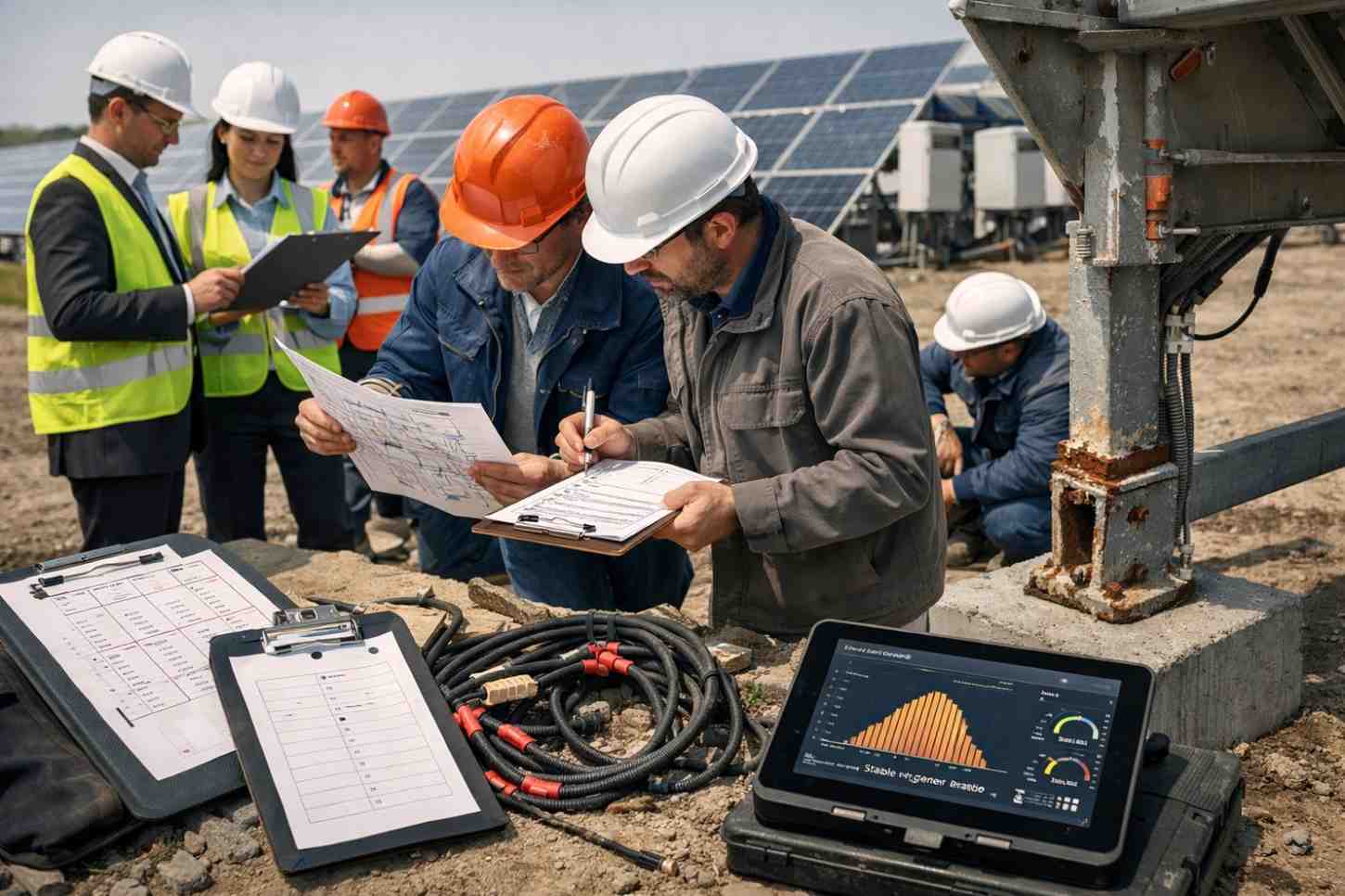
Due diligence teams are trained to assume that what is not documented did not happen. When inspection records are missing or maintenance histories are vague, confidence erodes quickly — regardless of current output.
This is why projects with identical performance can receive vastly different valuations.
Structural Uncertainty Is a Silent Deal-Breaker
Solar mounting structures rarely receive attention until they become a problem — or until someone external starts asking questions.
During due diligence, structures are re-examined with a different lens:
Were design margins conservative or minimal?
Has corrosion behaved as expected?
Are foundation drawings and load calculations available for reassessment?
If answers rely on assumptions rather than evidence, risk premiums rise.
Importantly, this does not mean the structure is failing. It means its future behavior cannot be confidently predicted — and unpredictability is expensive.
A practical explanation of how design margins, corrosion behavior, and reassessment readiness affect long-term asset credibility is covered in our Solar Mounting Structure Engineering & Risk Assessment Guide, frequently referenced during lender and insurer due diligence.
O&M History Reveals More Than Maintenance Quality
Due diligence teams don’t just look at whether maintenance was done.
They look at how it was approached.
Preventive O&M signals discipline and foresight.
Reactive O&M signals cost control under pressure.
Gaps in inspection frequency, inconsistent reporting formats, or undocumented corrective actions suggest that risk management may have been opportunistic rather than systematic. Over time, this perception affects trust far more than individual technical findings.
Documentation Is the First Casualty of Fast Growth
Many solar assets were built in high-growth phases where speed mattered more than traceability. Documentation suffered quietly.
Years later, when lenders or buyers request:
Historical inspection records
Structural modification logs
Corrosion mitigation evidence
teams scramble to reconstruct the past.
This reconstruction rarely satisfies external reviewers. Due diligence does not reward best guesses — it rewards continuity.
Why Storage & Repowering Trigger Failures Faster
When projects explore BESS integration, life extension, or repowering, due diligence intensifies. These decisions require confidence in the base asset.
What previously passed routine audits suddenly feels insufficient:
Structures must handle new loads
O&M systems must manage higher complexity
Historical decisions must be defensible
Projects that were “good enough” for standalone PV struggle to justify adaptability.
This is often where deals slow down — or collapse quietly.
The Real Reason Deals Fall Apart
Most solar deals do not fail with dramatic rejections.
They fail through delay, renegotiation, and confidence erosion.
Valuations are revised downward.
Insurance terms tighten.
Financing costs increase.
Eventually, enthusiasm fades — not because the asset is broken, but because it feels risky.
In due diligence, lack of clarity is treated as risk, even if the underlying issue is manageable.
What Strong Assets Do Differently
Projects that pass due diligence smoothly share a common DNA:
Structural decisions made with long-term margins
Preventive O&M ingrained from early years
Documentation treated as an asset, not an obligation
These projects don’t need to defend themselves aggressively. Their records speak calmly and consistently.
As solar markets mature, this quiet credibility is becoming the true differentiator.
Conclusion
Solar projects rarely fail due diligence because they stop producing power.
They fail because they cannot explain how — and why — they will continue to do so safely.
Performance gets attention.
Evidence earns trust.
In the next phase of the solar industry, success will belong to assets that understand this difference — and prepare for scrutiny long before it arrives.
