

Why Steel Quality, Not Price, Decides Long-Term Project Viability
For decades, steel procurement decisions have been dominated by a single metric: price. Whether for infrastructure, real estate, or industrial projects, the lowest quote often wins — especially in competitive tenders where margins are thin and timelines are tight.
But the global steel landscape is changing. Recent trade developments involving India, the USA, and Europe have reshaped not only pricing dynamics, but also expectations around quality, traceability, and compliance. In this environment, an uncomfortable truth is becoming increasingly clear: steel quality, not steel price, is what ultimately determines long-term project viability.
This shift is not theoretical. It is already visible in how projects age, how risks materialize, and how insurers, lenders, and large EPCs evaluate assets today.
In long-life infrastructure and real estate projects, consistent material performance — especially in TMT Steel Bars — plays a critical role in preserving structural reliability over decades.
Price Volatility Is a Market Reality. Quality Consistency Is a Strategic Choice.
Steel prices fluctuate for many reasons — raw material costs, trade policies, logistics disruptions, and global demand cycles. Trade agreements and import flows can temporarily suppress prices, creating short-term relief for buyers.
However, lower prices do not automatically translate into lower risk.
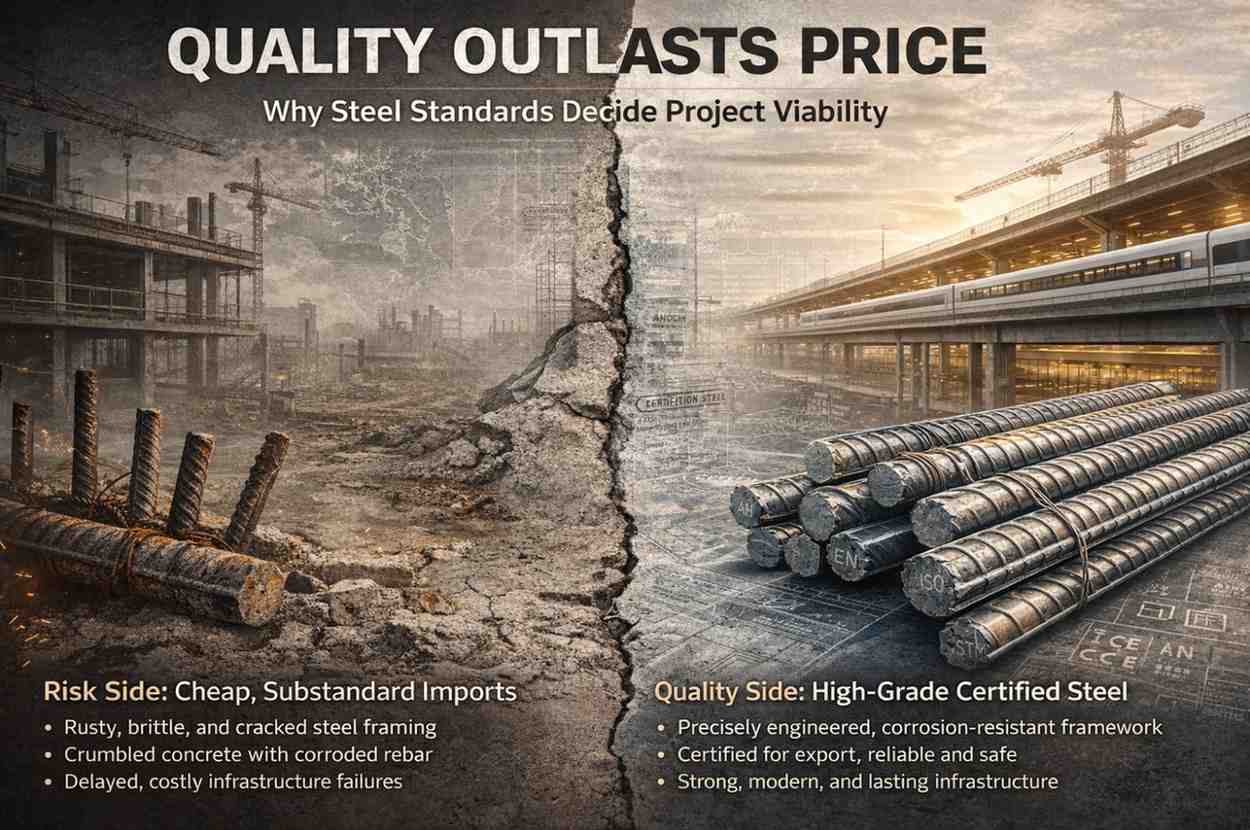
Projects that prioritize price over quality often experience inconsistent material properties, variations in yield strength, and weak corrosion resistance. These issues may not surface immediately, but over time they manifest as higher maintenance costs, structural degradation, and reduced asset life.
In contrast, projects that emphasize quality consistency — even during volatile pricing cycles — tend to maintain predictable performance over decades. This consistency becomes especially critical in long-life assets such as infrastructure, industrial plants, and renewable energy installations.
While global trade dynamics influence TMT Bar Prices, focusing only on upfront cost often ignores the long-term financial impact of material quality.
Why Cheaper Imports Can Increase Long-Term Risk
Global trade realignments have expanded access to lower-cost steel across markets. While imports can play a legitimate role in balancing supply, risk emerges when procurement decisions are driven solely by price differentials.
Cheaper steel may come with:
Limited traceability of raw materials
Inconsistent manufacturing standards
Incomplete certification or testing documentation
These gaps complicate quality assurance during execution and weaken confidence during future audits, refinancing, or asset transfers.
From a lifecycle perspective, even marginal compromises in steel quality can significantly increase maintenance intensity, accelerate corrosion, and reduce structural reliability — outcomes that often outweigh initial cost savings.
India’s trade deals with the USA & Europe are changing the rules of global manufacturing.
— SG Mart (@sgmart_official) February 10, 2026
Steel, exports & infra demand are next in line.
📊 Read the impact 👇https://t.co/a3hRcMdYrZ#IndiaTrade #SteelIndustry #GlobalEconomy #INDvsPAK #PiyushGoyal pic.twitter.com/PgQ1smD8fE
How Insurers, Lenders, and EPCs Evaluate Steel Quality Today
Institutional stakeholders no longer view steel as a commodity input alone. For insurers and lenders, steel quality is a risk signal.
Projects with documented steel sourcing, certification, and quality controls are perceived as:
Lower underwriting risk
More predictable in lifecycle behavior
Better candidates for long-term coverage and financing
Large EPCs increasingly align with this approach. Their evaluation frameworks extend beyond compliance at delivery and consider how steel performance affects warranties, operational liability, and long-term asset reputation.
In this context, price-only procurement appears increasingly misaligned with how modern projects are assessed.
Market leadership today increasingly depends on quality consistency and compliance — factors often highlighted in evaluations such as Top 10 TMT Bars in India
Lifecycle Value vs Upfront Savings
The true cost of steel is not captured at procurement. It unfolds over time — through inspection cycles, repairs, retrofits, and, in some cases, premature replacement.
When steel quality is prioritized:
Structural performance remains stable
Maintenance cycles are predictable
Asset value is preserved over time
When it is not, projects face compounding risks that erode both financial and operational outcomes.
This distinction explains why some projects remain viable for decades while others struggle to justify continued operation, insurance renewal, or refinancing — despite having started with similar designs and budgets.
A Quiet Separation Is Already Underway
The steel market is quietly dividing projects into two categories:
Those built for durability and confidence
Those optimized for short-term savings
Trade policies, imports, and pricing volatility have accelerated this separation, but they did not create it. The difference lies in procurement philosophy.
As infrastructure lifecycles extend and scrutiny from financial stakeholders increases, steel quality is no longer an optional consideration — it is a strategic determinant of project success.
Looking Ahead
As India deepens its integration with global markets, steel buyers will continue to face pricing pressure and competitive sourcing options. The projects that succeed will not be those that chase the lowest price, but those that understand how material quality underpins long-term value.
In the evolving steel economy, quality is not a cost — it is risk management.
