

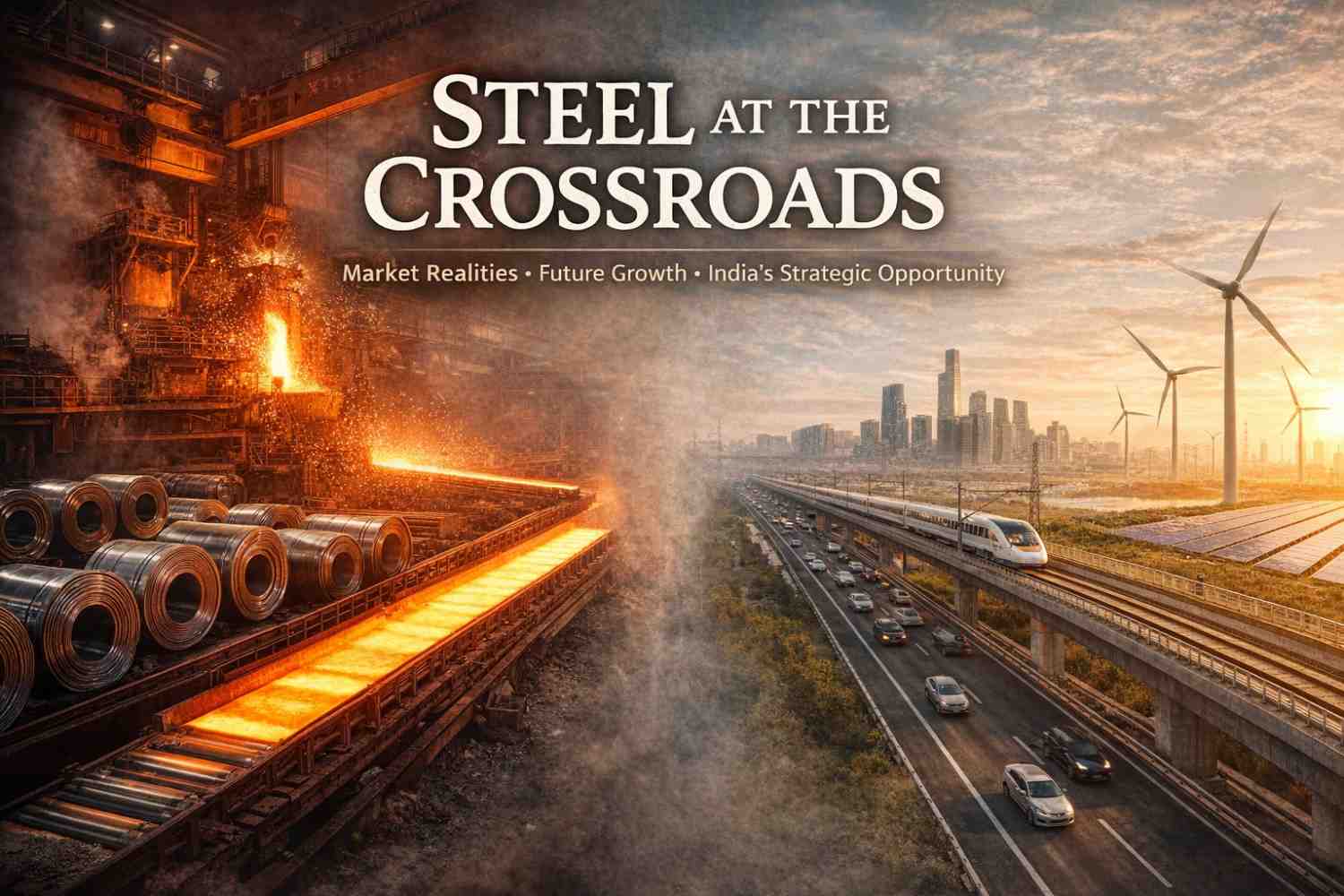
The steel industry — long a backbone of infrastructure and manufacturing — is experiencing a powerful transformation. After years of cyclical ups and downs driven by commodity swings, protectionist trade measures, and shifting demand centers, the sector is entering a new era of growth and challenge. For stakeholders across both B2B and B2C markets — from raw material suppliers and mill operators to end-users in construction, automotive, and consumer goods — understanding these trends is essential.
What is the outlook for the Indian steel industry in 2026?
India’s steel industry outlook remains strong through 2026, supported by infrastructure expansion, housing demand, and manufacturing growth. While global overcapacity and price pressure pose short-term challenges, domestic consumption, policy support, and rising use of TMT steel bars continue to drive long-term growth.
1. Current Market Scenario: Demand Outpaces Global Growth
Despite a subdued global demand environment, India’s steel industry continues to shine. While global steel demand growth is modest — constrained by surplus capacity and weak consumption in China and major Western economies — India stands out as a key growth engine.
According to a Jefferies-linked industry report, Indian steel production has increased strongly over the past decade, with output rising while global production declined, making India one of the few large markets showing consistent volume growth.
Key Stats:
India’s steel demand is projected to grow around 8–9% in FY26, outpacing many global peers.
Crude steel production climbed more than 10% recently, reflecting strong industrial activity and infrastructure demand.
Domestic demand growth continues even when global consumption slows, highlighting structural resilience.
This growth is primarily driven by robust domestic consumption linked to construction projects, infrastructure programs like the National Infrastructure Pipeline, and increasing usage in manufacturing sectors.
2. Price Dynamics and Margin Pressures
While demand is strong, pricing has been under pressure due to global oversupply and trade imbalances. A report by ICRA expects steel demand growth around 8% in FY26, but notes that increased incremental supply has created a temporary surplus, which has kept prices soft and margins flat.
Domestic prices such as hot-rolled coils (HRC) have fluctuated materially:
Prices spiked due to safeguard duties but later corrected due to supply conditions.
Protective duties remain critical to Indonesian and Chinese imports to support local producers.
This dynamic yields mixed signals: while demand is growing, profitability is constrained by pricing pressure, incremental capacity additions, and volatile raw-material costs.
These pricing dynamics are not limited to flat or coil segments alone. In the construction ecosystem, fluctuations directly influence TMT bar prices, impacting project budgeting, procurement timing, and contractor margins. As infrastructure activity accelerates, buyers increasingly track price trends alongside quality benchmarks to avoid long-term cost escalation.
3. Global Context: Overcapacity, Trade Flows & Protectionism
Globally, the steel industry grapples with excess capacity and trade imbalances. Supply additions from Asia and the Middle East continue, expect to push world capacity above 2.5 billion tonnes by the end of 2025.
Trade and Protectionism
India imposed safeguard duties and anti-dumping tariffs to protect domestic mills from cheap imports.
Despite Europe’s evolving carbon tariffs and protective measures, strong domestic consumption in India cushions the sector.
Chinese steel exports remain influential, compressing prices globally, even as domestic demand in China slows. This surplus challenges price stability and forces regional players to adapt their strategies.
4. Domestic Growth Drivers: Capex, Infrastructure & Production Expansion
Indian steelmakers are expanding rapidly — both in capacity and technology. Major players like Tata Steel and JSW Steel continue to report volume-led profit growth despite weak prices, highlighting strength in utilization and distribution networks.
Additionally:
PSU capex in the steel sector is projected to grow by ~44% in FY27, signaling government push for modernization and capacity enhancement.
New projects like advanced coating lines (e.g., Jindal India investing ₹11,000 crore) hint at a shift toward value-added products.
Plans for large integrated plants and slurry pipelines show focus on raw material linkage and supply efficiency.
These investments broaden the industry’s base, create jobs, and enhance India’s competitive positioning globally.
The backbone of this infrastructure-led demand continues to be TMT steel bars, which remain essential for residential construction, highways, bridges, and urban transit systems. With higher standards for seismic resistance and durability, the focus has shifted from volume alone to consistent quality and traceability across steel supply chains.
5. Raw Materials & Cost Inputs: Challenges Ahead
A critical future challenge for the Indian steel sector is securing raw materials at competitive prices:
Metallurgical coke shortages previously hit mill production due to import curbs, reflecting vulnerability in upstream supply chains.
Coking coal demand is forecast to surge, rising from ~87 MT in 2025 to 135 MT by 2030, compounding cost pressures.
Iron ore supply logistics remain a point of strategic planning, with large pipelines proposed to improve access.
Efficient raw-material access is essential for margin protection and future expansion.
6. Future Outlook: India as a Growth Engine
Looking ahead, India’s steel demand is expected to expand significantly:
Long-term projections suggest Indian steel demand could nearly triple by 2050, even as China’s share in global demand contracts.
Production capacity is forecast to reach 300 million tonnes by 2030, up from around 200 million today.
The transition toward value-added segments — automotive, appliances, and renewable infrastructure (like wind towers and solar mounting) — further diversifies the industry’s growth base.
At the same time, global concerns like decarbonization pressures and sustainable production methods will shape competitive advantages in the next decade.
7. B2B and B2C Impact: What Stakeholders Should Know
B2B (Manufacturers & Industrial Buyers)
Infrastructure boom: Construction, urban transit, and energy projects continue to anchor steel demand.
Trade measures: Domestic protection policies provide a cushion but require navigation of compliance and duty timelines.
Technology shift: Value-added products and downstream fabrication offer higher margins.
B2C (Consumers, Homebuilders, Auto Sector)
Housing demand: Residential steel consumption correlates with urban development and rural housing schemes.
Automotive recovery: Growth in mobility solutions boosts demand for high-strength automotive steel.
Price sensitivity: Consumer impact follows input cost changes; price volatility may influence end-product pricing.
For end-users and project planners, brand selection has become just as critical as price timing. Factors such as certification, consistency, regional availability, and performance history now influence buying decisions. A comparative overview of leading manufacturers can help buyers make informed choices based on application requirements and long-term reliability, as highlighted in this analysis of the Top 10 TMT bars in India.
Conclusion: Strategic Growth Amidst Structural Shifts
The Indian steel industry is at a strategic inflection point. While domestic demand remains robust, pricing and global overcapacity continue to pressure margins. Long-term growth is driven by infrastructure, rising manufacturing intensity, and supportive policy frameworks.
For investors, manufacturers, and supply chain participants, the key lies in balancing capacity expansion with cost efficiency, leveraging value-added production, and navigating evolving trade and raw-material dynamics.
India isn’t just surviving global slowdowns — it’s positioning itself as the next steel superpower in the 21st century.
