


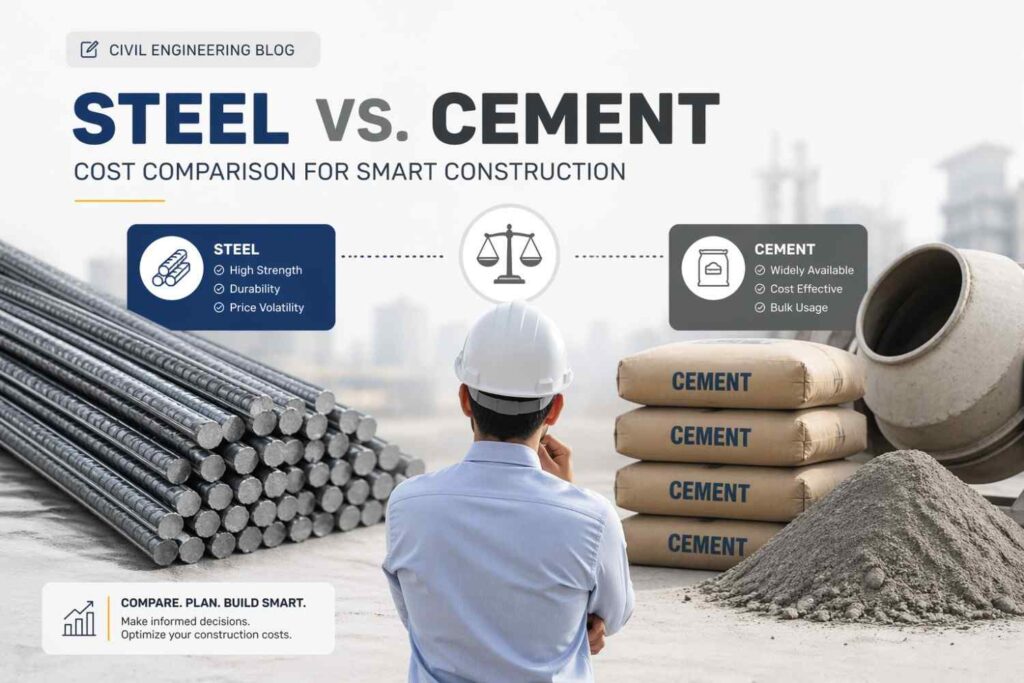
Steel vs Cement Cost Comparison (2026): What Drives Construction Costs Today?
Introduction
When planning any construction project—whether residential, commercial, or infrastructure—two materials dominate the cost structure: steel and cement. While both are essential, their pricing behavior, consumption patterns, and impact on total project cost are very different.
Understanding how steel and cement contribute to overall expenses is no longer optional—it’s a necessity for cost control, budgeting accuracy, and project efficiency.
Steel vs Cement: Quick Cost Comparison
Steel typically accounts for 15–25% of total construction cost, while cement contributes around 8–12%, depending on project type and design.
However, steel prices tend to be more volatile, making it a critical factor in cost fluctuations.
Steel vs Cement Cost Breakdown
| Factor | Steel | Cement |
|---|---|---|
| Cost Contribution | 15–25% | 8–12% |
| Price Volatility | High | Moderate |
| Usage Type | Structural strength | Binding material |
| Market Sensitivity | Global factors | Domestic demand |
| Cost Impact | High | Moderate |
construction material standards
Role of Steel in Construction Costs
Steel is the backbone of structural strength. It is used in:
- Reinforcement (TMT bars)
- Structural frameworks
- Load-bearing elements
Why Steel Costs Fluctuate More
- Global iron ore prices
- Energy and fuel costs
- Supply chain disruptions
- Import/export dynamics
This is why tracking latest TMT bar prices in India becomes essential for project planning.
🧱 Role of Cement in Construction Costs
Cement acts as a binding material, holding the structure together.
Used in:
- Concrete mix
- Plastering
- Masonry
🔹 Why Cement Prices Are More Stable
- Primarily domestic production
- Lower exposure to global volatility
- Controlled supply chain
👉 While cement costs rise, they usually do so gradually, not abruptly.
📉 Why Steel Impacts Your Budget More Than Cement
Even though cement is used in large quantities, steel has a disproportionately higher impact on project cost due to:
- Higher per-unit price
- Greater price volatility
- Critical structural role
👉 A small increase in steel price can significantly affect total budget.
📈 Cost Trends in 2026
🔹 Steel Trends
- Increasing demand due to infrastructure growth
- Price fluctuations due to global factors
- Shift toward higher-grade steel (Fe 500D, Fe 550D)
👉 steel demand trends in India
🔹 Cement Trends
- Stable demand growth
- Moderate price increase
- Regional price variations
⚖️ Steel vs Cement: Which One Should You Focus On?
👉 For cost control:
- Monitor steel prices regularly
- Plan bulk purchases strategically
- Optimize structural design
👉 For cement:
- Focus on efficient usage
- Avoid wastage
- Source locally for better pricing
💡 Practical Cost Optimization Tips
✔ For Steel
- Buy during price dips
- Choose appropriate grade (avoid overdesign)
- Work with reliable suppliers
✔ For Cement
- Optimize mix ratio
- Reduce wastage
- Plan procurement in advance
📉 Common Mistakes in Cost Planning
- Ignoring steel price trends
- Overestimating cement cost impact
- Not aligning material purchase with project timeline
👉 These mistakes often lead to budget overruns.
👷 Industry Insight
In real-world construction, cost overruns are rarely caused by a single material. However, steel often becomes the deciding factor due to its price volatility and structural importance.
Projects that actively monitor steel pricing and optimize usage tend to maintain better cost control compared to those focusing only on cement consumption.
📌 Conclusion
Both steel and cement are fundamental to construction, but their impact on cost differs significantly. While cement provides stability in pricing, steel introduces variability that can influence the entire project budget.
A balanced approach—monitoring steel trends while optimizing cement usage—ensures better financial planning and project efficiency.